
Okay, I want you to picture this. You’re walking through a centuries-old European square. There’s a cathedral glowing behind you. Tiny wooden stalls are covered in twinkling lights. Someone hands you a steaming mug of mulled wine. You can smell cinnamon, roasted nuts and gingerbread. There’s Christmas music playing. Maybe it’s even snowing.
And suddenly you’re thinking, “Why have I been spending December fighting for a parking spot at the mall?”
Welcome to the world of European Christmas markets. If you’ve been watching those ridiculously beautiful Christmas market videos thinking, “Someday I’m going to do that,” this guide might turn someday into this year. Consider this your Christmas markets 101: where to go, when to go, how to get around, what to eat and, most importantly, how early to book.
What Is a European Christmas Market?
Let’s clear something up. A European Christmas market isn’t simply a craft fair with Christmas decorations. These are traditions that go back centuries, and many of them can tell you exactly when they started.
You usually find them in historic town squares surrounded by churches, old buildings and cobblestone streets. Little wooden stalls sell ornaments, handmade gifts, candles, toys and local specialties.
And then there’s the food. The sausages, the gingerbread (you guys, the gingerbread), the roasted chestnuts, the potato pancakes, the pastries, the chocolate, the cheese and, of course, the glühwein: hot mulled wine flavored with spices.
One of my favorite little Christmas market traditions involves the mug. Many markets serve their glühwein in a special commemorative mug. You pay a deposit, and you can either return the mug and get your money back or keep it. Guess which option I always choose? I’m bringing the mug home. Forget the refrigerator magnet. Give me a little German Christmas mug from every city, and before long you’ve got the whole collection. And that, ladies and gentlemen, is how your obsession starts.
When Do European Christmas Markets Happen?
You’re probably saying, “Samantha, they happen over Christmas, and there’s no way I’m leaving my family for Christmas.”
Here’s mistake number one. People hear “Christmas market” and assume it happens over Christmas. Not necessarily, and every market is different, so you have to make sure you’re hitting the right dates.
Many European Christmas markets traditionally run from late November through December, but the dates vary. Some start around Thanksgiving, others a little later. And here’s the important part: some close before Christmas, because the people running them want to be with their families too. Others stay open through Christmas, and some continue into New Year’s.
So you can’t just book December 26 through January 2 and assume you’re getting Christmas markets. This is exactly the kind of trip where the details matter.
The Sweet Spot: Late November and Early December
If Christmas means a lot to you and your family, you want to be home for your own traditions and the parties. But you still want the Christmas markets. The sweet spot (don’t tell anyone I told you this) is late November and early December. You experience the markets in Europe, then come home, recover and get your own Christmas festivities going. One thousand percent.
Whether you’re booking a land trip or a river cruise, make sure it falls in that window. And if you’re booking flights for a land trip, double-check that the markets will actually be open while you’re there.
Where Should First-Timers Go? Start With Germany
If you want the quintessential Christmas market experience, Germany is hard to beat. It feels like there’s a Christmas market in literally every city.
Nuremberg is home to one of the world’s most famous Christmas markets. It’s the classic: red and white stalls, historic surroundings, gingerbread, sausages and glühwein. If the image in your head is a traditional German Christmas market, Nuremberg probably delivers exactly what you’re imagining.
Cologne is fantastic because you aren’t getting just one market. The city typically has several markets with different themes, plus the magnificent Cologne Cathedral towering above them. At night it’s absolutely gorgeous.
Munich is another great first-timer option because it’s a major city with plenty to do beyond the Christmas markets. If you fly over just for the markets on a land trip, you might see a market in a day and then wonder what to do with the rest of your time. In Munich you’ve got beer halls, shopping, museums and restaurants, and you can easily combine it with other destinations.
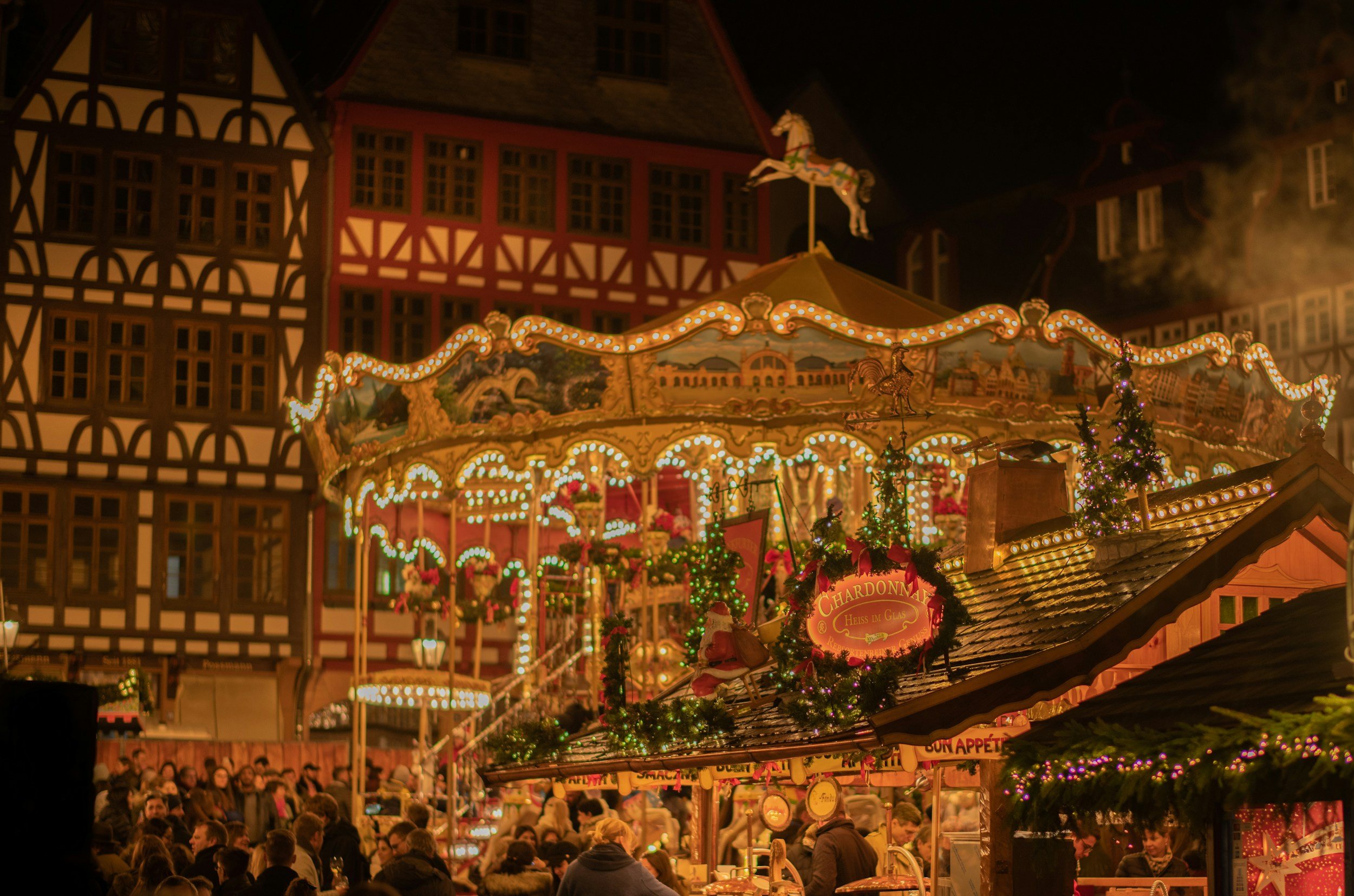
An illuminated carousel among half-timbered houses at Frankfurt’s Christmas market.
Austria: Christmas With a Little Extra Glamour
Nobody ever asks me to go to Austria, and I don’t know why. If you haven’t been, you’re missing out.
If Germany feels like traditional Christmas, Vienna feels like elegant Christmas. You’ve got magnificent architecture, palaces, cafés, classical music and beautiful Christmas markets throughout the city. Imagine walking around Vienna bundled in a coat, holding a warm drink, with one of Europe’s grandest buildings illuminated behind you. It’s romantic and sophisticated. If you’re planning a couples trip, Vienna should absolutely be on the list.
Salzburg is ridiculously pretty. There are mountains, baroque architecture, church bells and, of course, The Sound of Music. It’s Mozart territory, and at Christmas it’s storybook beautiful.
France: Strasbourg and Colmar
If you’ve seen Christmas market photos online that look almost too perfect to be real, there’s a decent chance you were looking at Strasbourg or Colmar. Half-timbered buildings, elaborate decorations, tiny streets covered in lights and Christmas trees everywhere.
Strasbourg famously markets itself as the Capital of Christmas. When you call yourself that, you’d better roll out all of the Christmas, and I think it’s phenomenal. It’s worth it.
Colmar already looks like someone built a fairy-tale village. Decorate it for Christmas and things get ridiculous. It’s perfect for photographs, romance and pure Christmas atmosphere.
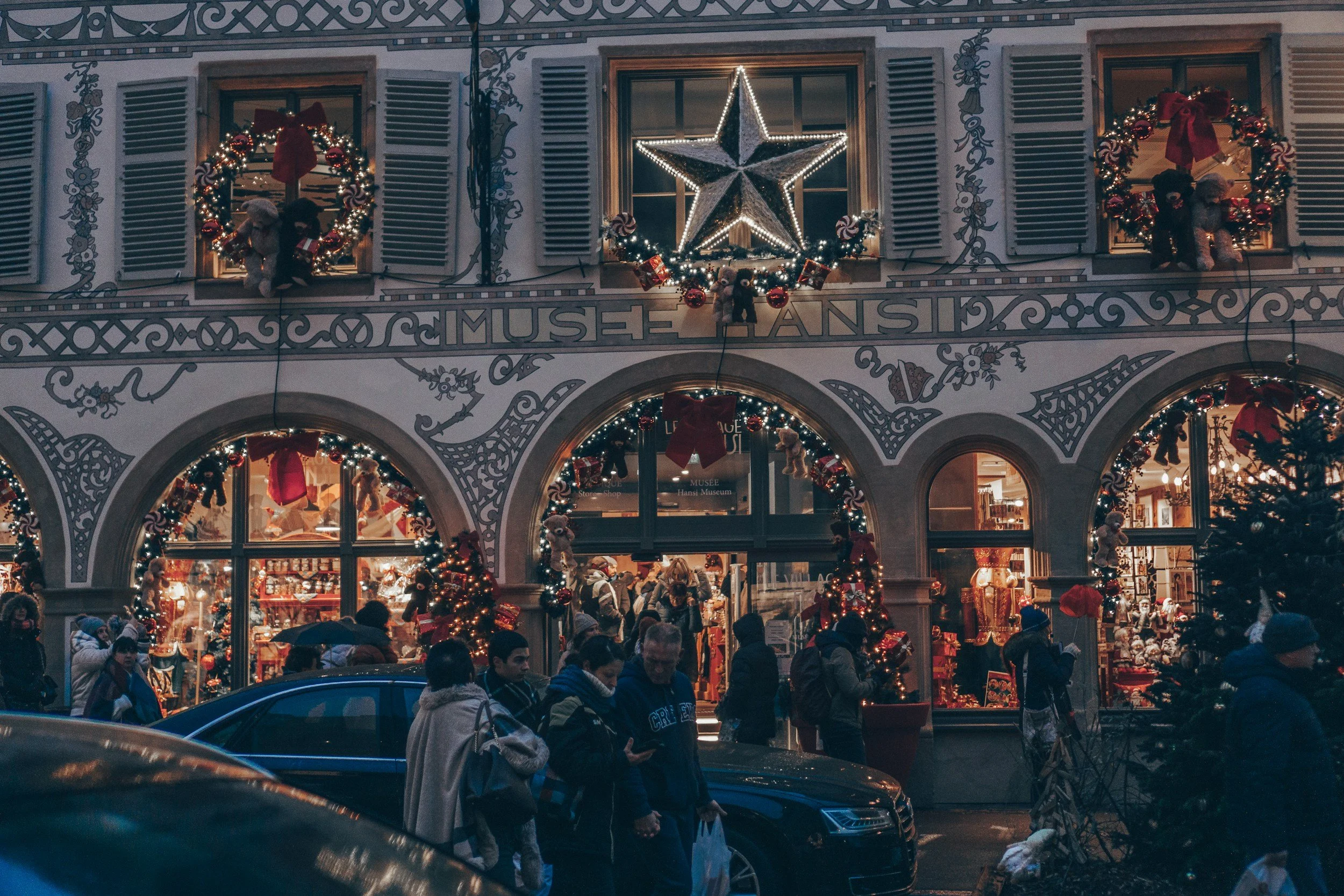
Colmar goes all out: a shopfront decorated for Christmas.
Now you’re probably thinking, “Germany sounds amazing, but so does Austria, and now I want France too.” Exactly. That’s where planning a Christmas market vacation gets complicated: which cities work together, and how do you get to all of them?
Why I Love a Christmas Market River Cruise
A river cruise might be my favorite way to introduce someone to the European Christmas markets, because it’s easy. You unpack once for the week and don’t have to lug your luggage around. All those mugs you’ve been collecting just line up on the desk in your cabin.
The coolest part is that you wake up in another European town. You go to sleep knowing there’s another Christmas market waiting tomorrow, and you didn’t have to ride a bus or take a train to get there. In the morning you get off the ship (I’d skip breakfast on board and go enjoy the pastries in town, because let’s be honest, they’re better at it), see the Christmas markets, get back on board, eat dinner, sleep and repeat.
The Rhine and the Danube are two of the biggest Christmas market river cruise regions. Depending on your itinerary, you might visit destinations across Germany, Austria, France, Switzerland, Hungary or neighboring countries.
That’s why it works so well for people who feel intimidated by planning Europe. You’re not coordinating six hotels, and you’re not figuring out trains or driving. You’re just on the ship.
River cruises aren’t cheap, and they’re not one-size-fits-all. There are luxury lines, more contemporary lines and more inclusive lines, so the hard part is picking the river cruise company that fits your needs and your budget.
Tourist Trap or Totally Worth It? Prague and Budapest
Prague: totally worth it. Prague is gorgeous throughout the year, but at Christmas it goes next level. You’ve got Old Town Square, Prague Castle, Gothic architecture and Christmas lights literally everywhere. Compared with some Western European capitals, travelers may find certain expenses more approachable, although Prague’s popularity means you shouldn’t automatically assume everything will be inexpensive. You can combine Prague with Vienna very easily, and the two cities give you completely different Christmas personalities.
Budapest: my secret spot. Budapest is becoming less secret every year, but I still think Americans underestimate it. At Christmas you get beautiful markets and dramatic architecture, and because it’s on the Danube you’ll hit it on many river cruises. One extra experience I absolutely love is the thermal baths. Imagine spending the day walking around cold Budapest and then slipping into warm thermal water. That sounds like heaven.
Budapest also works beautifully with Vienna because the cities connect easily by train. Now you’ve got Budapest, Vienna, maybe Salzburg or Prague, and somehow you’ve built an entire European Christmas market vacation.
What to Eat at European Christmas Markets
This is not a vacation where you survive on protein bars. You’re going to be eating.
Germany: bratwurst, German gingerbread, roasted nuts, potato pancakes and pretzels. Oh, the pretzels.
Austria: spätzle and schnitzel. Don’t miss the schnitzel: some of the best I have ever had was in Austria. You’d think it would be better in Germany. It’s not. Come fight me on that.
France: tarte flambée, cheese and pastries that melt in your mouth, plus vin chaud, the French version of hot mulled wine.
Budapest: chimney cake and lángos, a fried dough that can be topped with things like sour cream and cheese.
Because it’s cold, this is all hearty food. Your diet will probably go out the window this week, but you’re on vacation. It should anyway.
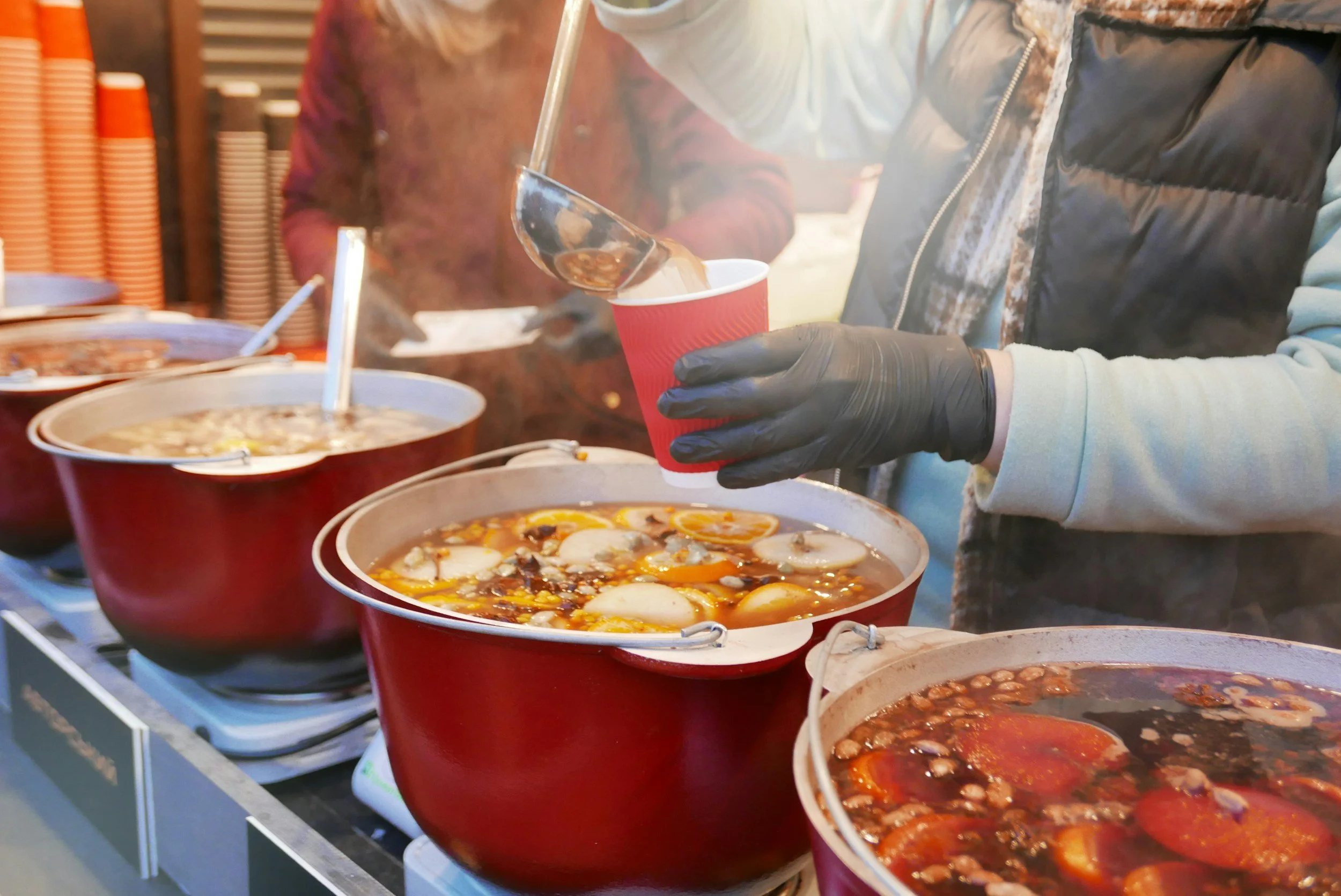
Hot mulled wine, ladled straight from the pot.
What to Pack for Christmas in Europe
This is where Floridians can get themselves into trouble. I’ve been trying to get my dad to do a Christmas market cruise forever, and he keeps telling me, “I’m not going. It’s too cold.”
It is totally cold, but that’s what gives it all of its ambiance. Living in Florida, it doesn’t always feel like Christmas, and that cold air is part of the feeling you see in the movies.
So pack layers and dress right:
Waterproof, comfortable boots, or waterproof sneakers
A warm jacket, scarves and hats
Gloves, ideally waterproof
Warm socks
Layer, layer, layer. And don’t underestimate your feet. If your feet are cold and wet by 3 p.m., you’re going to be done and heading back to the ship or the hotel. Dressing appropriately makes all the difference in the world.
Land Trip or River Cruise: Which Is Better?
Neither. They’re different, and it really depends on your personality. That’s how I explain it to my clients.
Choose a land vacation if you want maximum flexibility. You’re in charge, and if you’re done with a town, you leave. Choose land if you want nightlife (you’re not going to get much on a river cruise), specific restaurants or boutique hotels, if you want the experience of living among the locals, if you don’t mind trains and if you want to spend several nights in each destination.
Choose a river cruise if you want simplicity. You don’t want to constantly pack and unpack, you want to see multiple towns, you like having meals and logistics handled and you want Europe to feel easier.
Or do both. You could spend three nights in Vienna, board a river cruise and end up in Budapest. Combining the two can be the best-case scenario.
Rapid-Fire: Christmas Market Edition
Germany or Austria? Germany for tradition, Austria for elegance.
Big city or small town? Both, because you get two different experiences.
One giant famous market or several smaller markets? Several smaller markets.
Glühwein or hot chocolate? I’m a kid at heart when it comes to my taste buds, so hot chocolate.
Christmas ornament or souvenir mug? I guess both.
River cruise or train? It depends on the traveler.
Carry-on only? No. With all the stuff I’m going to buy, I can’t do it.
Best time to go? Late November or early December, 100%.
Snow guaranteed? Absolutely not. Don’t book expecting a Hallmark movie snowstorm on command. If it snows, it’s magical. If it doesn’t, you’re still standing in a medieval European city with a hot chocolate, surrounded by twinkling lights.
Who Is a Christmas Market Trip Perfect For?
Honestly, anybody. It’s not just for couples. A girls’ trip would be so much fun, because you’re out shopping most of the time (while the men are probably at the bar with a pretzel and a beer). It’s also a great mother-daughter trip, couples trip or multigenerational family trip during the holidays, and the trip itself could be your Christmas present to each other.
Final Boarding Call: Don’t Wait to Plan
If you’ve always dreamed of experiencing Christmas in Europe, stop putting it on your someday list. This trip delivers something that’s increasingly difficult to find: actual magic. Not manufactured magic, and not a theme-park version with fake snow. Centuries-old town squares, church bells, local traditions, families gathering, recipes passed down through generations, cold air, warm wine, Christmas lights reflecting off cobblestones, and that moment when you look around and think, “I can’t believe I’m actually here.”
Just remember: a Christmas market vacation isn’t simply “book Europe in December.” Dates matter. Locations matter. Hotels, transportation and the itinerary really matter. Munich, Vienna, Strasbourg, Prague and Budapest may all sound fabulous, but that doesn’t mean you should randomly string them together.
That’s exactly why you use a professional travel advisor. At Fabulous Adventures Travel, we can help you decide whether you’re better suited to a Christmas market river cruise, a custom European land itinerary or, my personal favorite for some travelers, a combination of both. We’ll help with flights, hotels, trains, transfers and tours, and, most importantly, we’ll make sure you don’t arrive two days after the market you flew across the Atlantic to see has closed, or before it has opened.
And my biggest piece of advice: do not wait until November to start planning November. These trips fill up, and Christmas market river cruises sell as much as two years in advance.
Maybe it’s Germany. Maybe it’s Austria. Maybe it’s France. Maybe it’s a river cruise. Maybe it’s all of the above. Until next time, keep your passport ready, vacation smarter and travel harder.
