
Have you ever looked at a European vacation and thought, “Okay, I want to go to Italy, but I also want Greece, and maybe Croatia, and since I’m already over there, Paris sounds good”? And then suddenly you’re looking at trains, ferries, discount airlines, rental cars, airports you’ve never heard of and train stations whose names you can’t pronounce, and you close the laptop because it all sounds a little confusing.
I’m fixing that today, because one of the biggest reasons Americans stay away from Europe isn’t that they don’t want to go. They’re intimidated by getting around. Which airport do I fly into? Do I take a train? Should I rent a car? Are European budget airlines really that cheap? And why does Google Maps suddenly want me to take a train, a ferry, a bus and then walk seven minutes with my suitcase? Welcome to Europe.
But here’s the secret. Once you understand the transportation, Europe can actually be easier to navigate than the United States. So let’s talk planes, trains, automobiles, ferries, cruises and everything in between, including one of my absolute favorite European travel strategies: fly direct.
Why Europe Feels Intimidating (and Why It Shouldn’t)
I hear this constantly: “I’d love to go to Europe, but I don’t know where to start.” And I completely understand why. It’s an ocean away. The countries are the size of states, yet they’re all close together, and every time you cross a border, people speak a completely different language. When Americans vacation at home, we’re used to a certain rhythm: we fly somewhere, rent a car, drive around, done. Europe works differently.
You could go to London, take the Eurostar to Paris, fly to Barcelona, take a train to Madrid, rent a car through Portugal and cruise home from Lisbon. There isn’t one correct way to do it. It’s what works best for you, and that’s actually what makes Europe incredible. You have choices.
A lot of people also assume you just take the train everywhere. “If I’m in Italy and I want to go to Paris, I’ll just take the train.” Oh, no. That’s going to be a very, very long day when the flight is about two hours, if that.
Then come the what-ifs. What if everything at the train station is in Italian? What if I get on the wrong train? What if I can’t figure out the metro? What if I rent a car and end up driving through a medieval village where the road is approximately 6 inches wider than my vehicle? Okay, that last one is a legitimate concern. I’ve actually done it. It was scary, but I survived to tell you about it.
Here’s what I want you to remember: millions of tourists navigate Europe every year. You don’t need to speak six languages. English is pretty prevalent over there, but please don’t assume everyone speaks it. That’s one thing they really don’t love about us Americans. Google Translate has worked out very well for me many, many times, so make the effort. You also don’t need to understand every train system before you leave home, and you definitely don’t have to see 12 countries in 10 days. The trick is choosing the right transportation for the right trip.
Go It Alone or Join a Group?
Before we get into transportation, know that there are two very different ways to do Europe. The first is an individual trip. It’s you, your family or your travel companions, following your own path and doing your own thing, whether you design it yourself or have a travel advisor design it for you.
The second is group travel, which a lot of new travelers don’t realize exists. You buy into a group that’s already set up, with the itinerary created for you. The big benefit is that everything is done for you, right down to your luggage being moved between hotels and back on the bus. Your only job is to show up and enjoy yourself.
I’ll be honest: I’m not a huge fan of group travel, because I like to be in charge of my own time. You have to be on the bus at 8 a.m., and Joe Smith decides he didn’t get his coffee and shows up at 8:20. You’re herded along as a large group, and sometimes you wait for your room key when everyone checks in at once. But I want you to know you don’t have to go it alone. And the third way, cruising, we’ll get to in a minute.
My Favorite Europe Tip: Start With a Nonstop Flight
When you’re planning a Europe trip, stop obsessing over flying into the city where your vacation starts. Instead, look at the best nonstop flight across the Atlantic.
Say you want to go to Venice and Vienna, and there’s no direct flight from Orlando to Venice. Don’t try to force Orlando to Venice. If there’s a direct flight to Vienna, start your trip in Vienna. From Orlando, for example, you can fly direct to London, Paris, Rome, Dublin and Vienna, and now Lisbon too. I’m sure I’m missing some.
So start with your home city: where can you fly nonstop? Then ask what you can reach easily from there, whether that’s a train or another flight, and build your trip from that point. Connections are where things start to go a little crazy. You miss a flight, you’re stuck somewhere, and you’ve lost the first day of your vacation.
Here’s my unpopular opinion, and everyone can throw tomatoes at me: if you have a choice between a nonstop flight and a connection, even a connection on your preferred airline, 100% always choose the nonstop.
How Your Route Can Change (a Real Example)
This happens to me too. We’re currently planning a trip to Split. It started out with Paris, then we found out there was no direct flight from Paris to Split on the day we needed. So Paris was scrapped and we looked at Rome, but Rome prices were outrageous at the time. Now we’re looking at flying into Lisbon, where the prices are pretty decent, spending a little time there, then going to Rome and on to Split. I was hoping to take a really cool picture in Paris, and that doesn’t seem to be happening, which is totally fine. Once you start looking at it this way, it changes the whole trajectory of your trip, often for the better.
Europe by Train
Europe is great at trains. Americans sometimes treat European trains like a mysterious system requiring an engineering degree, because we hardly have them here. Over there, for certain city pairs, trains are absolutely fantastic.
London to Paris on the train is genius. There’s also a quick, inexpensive flight on that route, so you have options. Paris to Brussels, Florence to Rome, Rome to Venice (a good one, because Venice is hard to get to) and Madrid to Barcelona are the kinds of routes where I’m asking, “Why are we flying?”
Here’s what people forget when they compare a 1-hour flight to a 3-hour train ride. With the flight, you have to get to the airport, arrive early, check your luggage, go through security, wait at the gate, board, fly, land, wait for your luggage, and then get from an airport that may be well outside the city into downtown. Meanwhile, the train takes you right into the city center. You get on, put your bag away, sit down, and suddenly you’re watching the French countryside go by while eating a croissant.

For trips of about 4 hours or less, the train often beats flying door to door.
When Should You Take the Train?
Here’s my rough rule: if the train is around 4 hours or less, consider it over flying. Travel time isn’t just the time you’re physically in the air. Compare the door-to-door time, and that’s where trains often win.
And don’t forget overnight trains. Europe has been bringing back more sleeper trains, and for the right itinerary they can be such a fun experience. You go to sleep in one city and wake up in another, and your transportation and hotel room are combined.
European Budget Airlines
You’ll see European airfares for €29 and think it has to be a scam, that they’ve duct-taped the plane together. Sometimes it really can be that inexpensive. But it works the same way as budget airlines here: you buy a ticket onto the plane, and then you pay for your seat, your luggage and everything else. Pay close attention so you know what you’re buying, and compare the total cost.
Europe has an enormous network of low-cost carriers, which is great. You can hop between London, Italy, Paris, Spain and Greece. I once got a phenomenal fare from Paris to Greece. Greece is a lot farther from Paris than people realize, so that’s a trip you fly, not one you take by train.
Don’t panic about the budget carriers. They’ve been flying over there for years (Ryanair is one of them). You don’t have to take a full-service airline, so save yourself some money.
Here’s a big one: make sure the airline flies into the main airport, not a smaller airport well outside the city. Otherwise you land, look around at the farms and realize you now have to figure out how to get into the city.
Renting a Car in Europe
There are European vacations where I absolutely want a car, and others where you couldn’t pay me to have one.
Rent a car for the countryside: the UK outside London (yes, even though they drive on the other side of the road), Tuscany, the Scottish Highlands, which I’ve driven, and small villages in rural France. Wineries, castles, beaches: you’ll want a car.
Skip the car in big cities: Paris, London or any big city. You’ve got the metro, rideshares and everything else, and you don’t need one.
I promise you, the small roads are chaos. When the streets get narrow and cars are parked along them and you’re trying to squeeze through, I literally scream. And don’t forget your luggage: I have had many panics trying to fit all of our bags into what Europe considers one of its biggest cars.
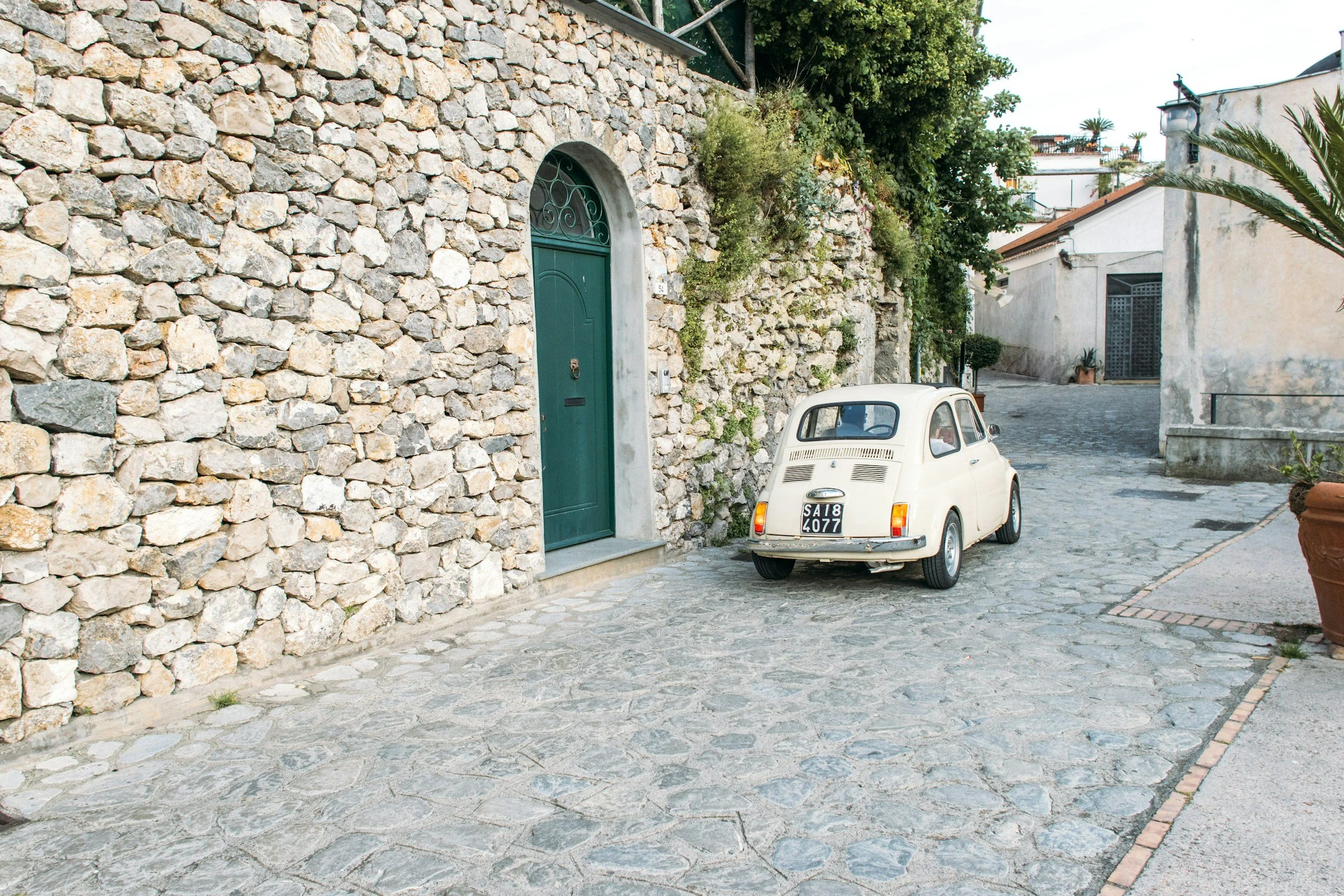
Country roads and village lanes in Europe can be barely wider than the car.
Before You Drive
Research whether you need an International Driving Permit. Some countries require one and some don’t.
Understand the toll systems.
Learn the road signs and where you’re allowed to drive. They’re different from ours.
The one you always see on The Amazing Race: manual transmission. Make sure you know how to drive a stick, or rent an automatic.
Don’t Overlook the Ferries
One of the most underrated ways to travel in Europe is the ferry, especially in Greece, Croatia and parts of Italy. People automatically assume they have to fly, but there’s probably a ferry option.
Picture this: you’re in Athens, you head to the port, you get on a ferry, and in a few hours you’re stepping onto a Greek island. That’s not a transfer. That’s a vacation. The same goes for parts of the Croatian coast. Sometimes you don’t want to fly over that scenery. You want to travel through it.
Check the ferry schedules, because sometimes it’s still better to fly, and keep busy season in mind, because it gets very crowded.

Arriving by ferry: in Greece, Croatia and parts of Italy, the journey is part of the vacation.
Cruising Europe: Your Floating Hotel
If all of this scares you, cruising as transportation is a definite option. A Mediterranean cruise is essentially a floating hotel that moves you from country to country while you sleep. Italy today, France tomorrow, Spain the next day, maybe Greece, Croatia or Montenegro, and you only unpack once.
This is why I love cruising for people who are intimidated by Europe, or who find rental cars, hotels and dragging luggage across cobblestone streets way too daunting. It gives you a taste of several destinations so you can figure out which ones you love and go back.
Don’t Try to See All of Europe at Once
I say this all the time, and it’s worth saying again: don’t try to see all of Europe in one trip unless you have the time. Give each destination the attention it deserves. Go off the path and wander. Check out some places that aren’t as popular, because that’s where you actually experience the culture and find that awesome place you didn’t expect.
Europe isn’t difficult. It’s just different. Once you stop trying to travel through Europe exactly the way you travel through the United States, everything starts making sense. Sometimes the smartest answer is a train. Sometimes it’s a ferry, a rental car or a cruise ship. And sometimes my favorite travel hack is simply finding the nonstop flight.
If you still don’t know where to start, my team at Fabulous Adventures Travel can help you figure out the best way to get there, whether that’s an individual trip we design for you, the right group tour (there are definitely differences between groups) or the right cruise.
